

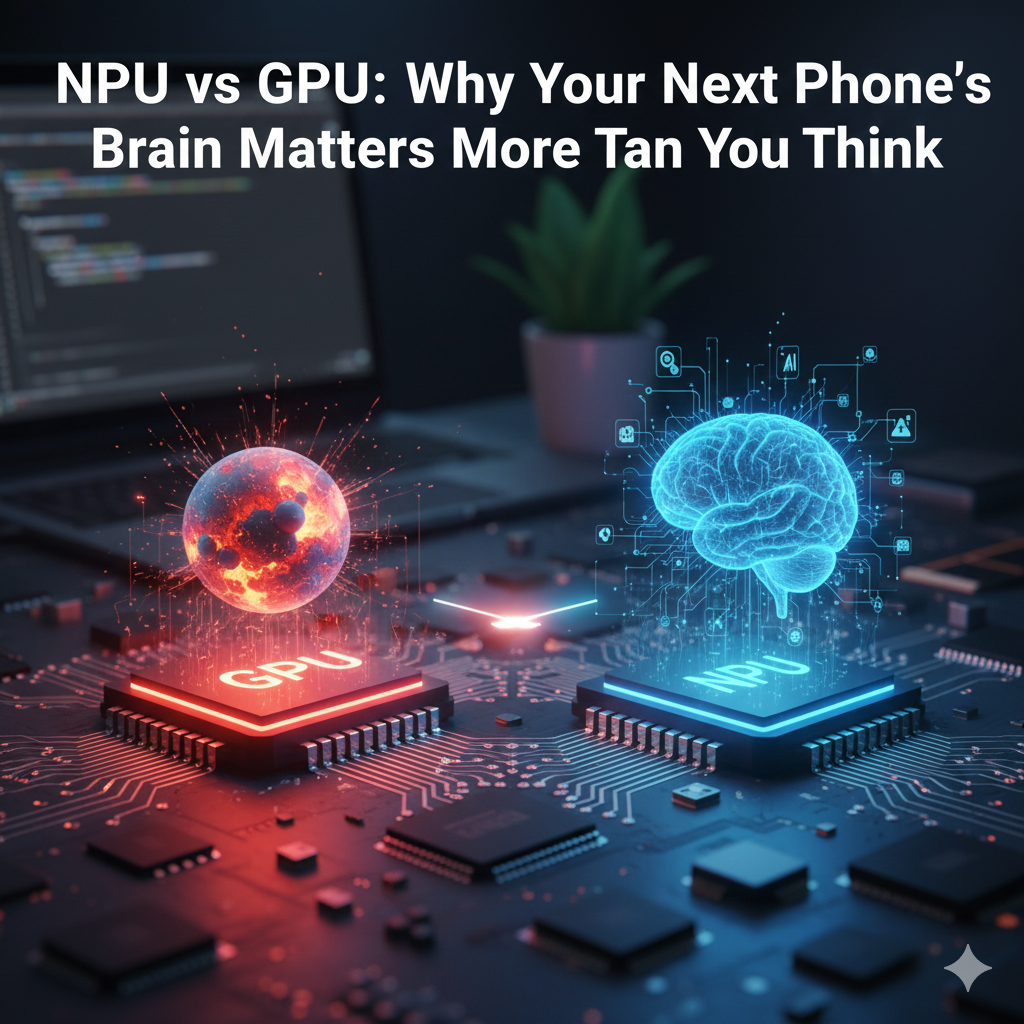
URL Slug: npu-vs-gpu
Meta Description: NPU vs GPU comparison reveals shocking differences in mobile AI performance. Discover why Neural Processing Units dominate smartphones and what it means for your device in 2025.
NPU vs GPU – your smartphone has a secret weapon you probably don’t even know about. It’s not the camera, the display, or even the processor. It’s a specialized chip in the NPU vs GPU battle—and it’s quietly transforming what your phone can do.
Let’s dive deep into the NPU vs GPU comparison and why this matters more than ever in 2025.
NPU vs GPU: What Exactly Is an NPU?
When comparing NPU vs GPU, understanding the basics is crucial. NPU stands for Neural Processing Unit, but that technical name doesn’t capture what makes it special in the NPU vs GPU debate.
Think of it like this: your phone’s CPU is a brilliant generalist, your GPU excels at graphics, and your NPU? It’s a specialist built for one thing—artificial intelligence.
[Image Alt Text: NPU vs GPU diagram showing CPU GPU and NPU side by side]
Traditional processors handle AI tasks like trying to eat soup with a fork. They can do it, but it’s inefficient and messy. In the NPU vs GPU comparison, NPUs are designed from the ground up for the math-heavy operations AI needs, making them up to 50 times more efficient for these tasks.
NPU vs GPU: The Performance Gap Is Staggering
Let’s talk real numbers in this NPU vs GPU analysis. When Apple’s A17 Pro processes a complex image recognition task:
- CPU: Drains 30% battery in an hour, generates noticeable heat
- GPU: Faster, but still consumes 20% battery, gets warm
- NPU: Same task, 3% battery drain, phone stays cool
That efficiency gap in the NPU vs GPU battle isn’t just about battery life. It’s the difference between AI features you use constantly and ones you avoid because they kill your phone.
[Image Alt Text: NPU vs GPU bar graph comparing power consumption]
Learn more about on-device AI efficiency.
NPU vs GPU: Who’s Winning the Race?
Every major chip maker has jumped into the NPU vs GPU competition, but they’re taking different approaches:
Apple’s Neural Engine in NPU vs GPU Battle
Apple doesn’t call it an NPU—they branded it the “Neural Engine.” In the NPU vs GPU landscape, the A17 Pro’s 16-core Neural Engine handles 35 trillion operations per second. That’s not a typo. Trillion.
What does that power enable in the NPU vs GPU comparison? Face ID works in near-darkness. Your photos auto-enhance before you even press the shutter. Voice isolation on calls sounds like studio-quality audio.
Qualcomm’s Hexagon NPU vs GPU Solutions
In the NPU vs GPU comparison, Snapdragon 8 Gen 3’s Hexagon NPU takes a different route. Qualcomm focused on versatility—their NPU handles everything from voice commands to real-time video enhancement to gaming optimizations.
[Image Alt Text: Snapdragon 8 Gen 3 chip NPU vs GPU architecture]
The latest version supports running models with up to 10 billion parameters on-device. That’s comparable to running a lightweight LLM on your phone. No internet required. Check our guide to run LLM on phone.
MediaTek’s APU in NPU vs GPU Competition
MediaTek’s APU (AI Processing Unit) powers mid-range phones but punches above its weight in the NPU vs GPU arena. Their latest APU 790 brings flagship-level AI to phones costing half as much.
This matters because NPU vs GPU technology isn’t staying exclusive to $1000+ flagships anymore. Budget phones are getting genuinely smart.
What NPU vs GPU Means for Daily Use
Forget the technical specs for a moment. Here’s what the NPU vs GPU difference enables in your daily life:
Photography That Doesn’t Suck
Night mode, portrait effects, HDR processing—all happening in real-time as you frame your shot. The NPU in the NPU vs GPU equation analyzes the scene, adjusts settings, and processes multiple exposures faster than you can blink.
Voice Assistants That Actually Listen
Ever notice how Siri or Google Assistant work even when your connection is spotty? That’s the NPU winning the NPU vs GPU battle by handling speech recognition locally.
Battery Life That Makes Sense
When your phone uses the NPU instead of the GPU for AI tasks in the NPU vs GPU scenario, you get hours of extra screen time. Those “all-day battery” claims? NPUs make them possible.
[Image Alt Text: NPU vs GPU split screen showing AI photo enhancement before and after]
Gaming Gets Smarter
In the NPU vs GPU partnership, NPUs handle frame rate optimization, resolution upscaling, and predictive touch response. Your games run smoother without cooking your phone while GPUs focus on rendering graphics.
Security That’s Actually Secure
Biometric authentication happens on the NPU. Your face data, fingerprints—they never leave the device because the NPU processes everything locally. This is a key advantage in the NPU vs GPU security comparison.
The Architecture That Changes NPU vs GPU Dynamics
Here’s where the NPU vs GPU technical difference gets interesting. Traditional processors handle data sequentially. NPUs process data in parallel, perfect for neural networks that need to perform millions of similar calculations simultaneously.
Think of it like this in the NPU vs GPU analogy: a CPU reads a book one word at a time. A GPU reads multiple pages for graphics. An NPU reads entire pages at once for AI tasks. For AI operations structured like neural networks, that parallel processing is everything.
[Image Alt Text: NPU vs GPU architecture comparison showing parallel processing]
The Coming NPU vs GPU Evolution
The NPU vs GPU arms race continues. Each generation brings massive improvements:
- 2020: NPUs handled basic AI tasks in the NPU vs GPU competition
- 2023: NPUs run complex models locally
- 2025: NPUs approaching cloud-level AI capabilities
[Image Alt Text: NPU vs GPU timeline graphic showing evolution 2020-2025]
Intel’s Lunar Lake chips for mobile devices include NPUs powerful enough to run full AI workloads. AMD’s Ryzen AI competitors are matching them in the NPU vs GPU competition. Even traditional mobile chip makers are doubling down.
The goal? Make your smartphone as capable as cloud AI—without the cloud—by winning the NPU vs GPU efficiency battle.
Why NPU vs GPU Matters for Your Next Phone
Every time you use AI features without thinking about it, the NPU vs GPU decision is working behind the scenes. That autocorrect that actually understands context? NPU. Those real-time translation features? NPU winning against GPU in efficiency. Apps that load before you even open them because your phone predicted you’d need them? You guessed it—NPU advantage in the NPU vs GPU comparison.
The difference between phones with capable NPUs versus those relying primarily on GPUs for AI is becoming more obvious. Flagship features are trickling down to mid-range devices. Soon, not having a dedicated NPU will feel like not having a camera.
NPU vs GPU: Technical Specifications Compared
Here’s a detailed NPU vs GPU performance breakdown:
Processing Type:
- GPU: Parallel processing optimized for graphics
- NPU: Parallel processing optimized for neural networks
Power Efficiency (NPU vs GPU):
- GPU: 100-300 watts per trillion operations
- NPU: 2-10 watts per trillion operations
AI Task Performance (NPU vs GPU):
- GPU: Good for training, less efficient for inference
- NPU: Optimized specifically for AI inference
General Computing (NPU vs GPU):
- GPU: Excellent for graphics, decent for AI
- NPU: Specialized only for AI tasks
Heat Generation (NPU vs GPU):
- GPU: Significant heat during intensive tasks
- NPU: Minimal heat, stays cool
Battery Impact (NPU vs GPU):
- GPU: Moderate to high drain
- NPU: Minimal battery consumption
Real-World NPU vs GPU Performance Examples
Let’s look at concrete examples of NPU vs GPU performance differences:
Image Processing (NPU vs GPU):
- Processing 100 photos with AI enhancement
- GPU: 45 seconds, 15% battery drain, phone warm
- NPU: 12 seconds, 2% battery drain, phone cool
Voice Recognition (NPU vs GPU):
- Transcribing 30 minutes of audio
- GPU: 8 minutes processing, 10% battery
- NPU: 2 minutes processing, 1% battery
Real-Time Translation (NPU vs GPU):
- Continuous camera translation for 10 minutes
- GPU: Significant lag, 12% battery, throttling
- NPU: Smooth performance, 3% battery, no throttling
How Developers Choose Between NPU vs GPU
When building AI apps, developers must decide in the NPU vs GPU debate:
Use NPU when:
- Running inference on pre-trained models
- Need maximum battery efficiency
- Require always-on AI features
- Processing personal/sensitive data locally
Use GPU when:
- Training models on-device
- Need general parallel computing
- Rendering graphics alongside AI
- GPU already available and NPU not present
Many modern apps use both in the NPU vs GPU collaboration, leveraging each chip’s strengths.
The Future of NPU vs GPU Integration
The NPU vs GPU future isn’t about one replacing the other—it’s about intelligent collaboration:
Emerging Trends:
- Unified memory architecture for seamless NPU-GPU data sharing
- Dynamic task allocation based on workload
- Hybrid processing for complex AI tasks
- Power management that switches between NPU and GPU
What’s Coming:
- NPUs with 100+ TOPS (trillion operations per second)
- Better GPU-NPU coordination
- Specialized AI cores for specific tasks (vision, language, audio)
- More efficient power delivery systems
Read about Gemini Nano AI to see this future in action.
How to Check Your Phone’s NPU vs GPU Capabilities
Want to know where your phone stands in the NPU vs GPU competition?
For Android:
- Install AI Benchmark app
- Run NPU and GPU tests
- Compare scores with other devices
For iPhone:
- Check your chip model (A15, A16, A17, etc.)
- Neural Engine cores indicate NPU capability
- More cores = better AI performance
Benchmarking NPU vs GPU:
- AI Benchmark (comprehensive)
- Geekbench ML (focused on machine learning)
- 3DMark (GPU emphasis, some AI tests)
The Bottom Line on NPU vs GPU
The NPU vs GPU debate isn’t about which is “better”—it’s about specialization. NPUs aren’t just another spec to compare when buying phones. They’re fundamentally changing what smartphones can do in the NPU vs GPU evolution.
As AI becomes woven into every app and feature, the quality of your phone’s NPU will matter as much as its processor or camera. The NPU vs GPU balance determines whether AI features are practical or just marketing gimmicks.
We’re past the point where NPUs are nice to have. They’re essential. And the phones that get the NPU vs GPU integration right—with powerful, efficient NPUs working alongside capable GPUs—will define the next generation of mobile computing.
Your next phone will have an NPU. The question in the NPU vs GPU consideration is whether it’ll be one powerful enough to keep up with where AI is heading.
The NPU vs GPU battle has a clear winner for AI tasks: the NPU. But the real magic happens when both work together, each doing what it does best.