

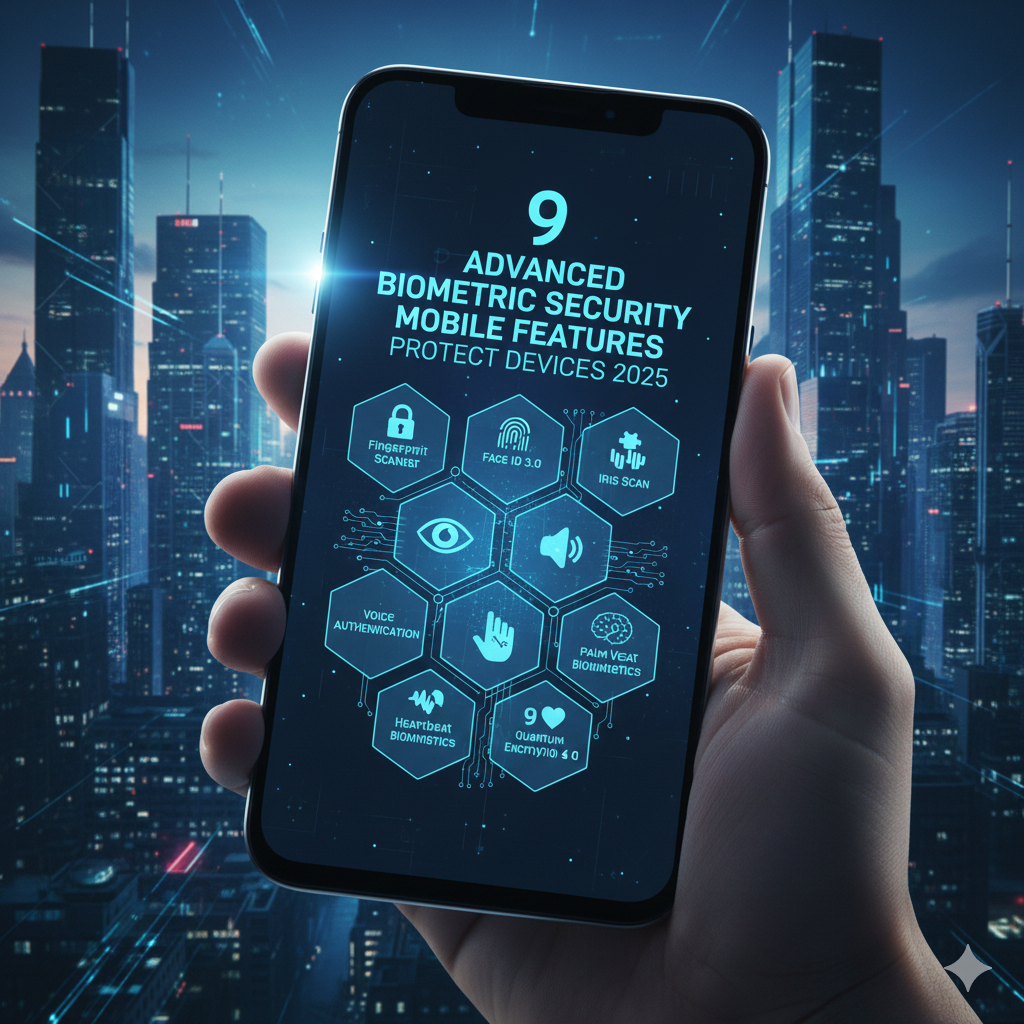
Biometric security mobile systems use unique biological characteristics to authenticate users, replacing passwords with fingerprints, faces, and voices. Modern biometric security mobile technology combines convenience with protection, enabling instant device unlocking while maintaining security standards that exceed traditional authentication methods.
This comprehensive guide examines biometric security mobile implementations, comparing different modalities, analyzing security effectiveness, and revealing how artificial intelligence enhances both accuracy and fraud resistance in mobile authentication.
[Image Alt Text: biometric security mobile authentication methods fingerprint face voice]
Understanding Biometric Security Mobile
Contemporary biometric security mobile systems analyze unique physical and behavioral characteristics that identify individuals. Unlike passwords that can be stolen or forgotten, biometric security mobile features measure something intrinsically part of you.
The technology works by capturing biometric data, extracting distinguishing features, creating mathematical templates, and comparing new samples against stored templates. Modern biometric security mobile processing happens locally on devices, protecting privacy while delivering instant authentication.
Major technology companies including Apple, Samsung, Qualcomm, and Google invest heavily in biometric security mobile innovation, competing to deliver most secure yet convenient authentication experiences.
How Biometric Security Mobile Works
Understanding mechanics behind biometric security mobile helps appreciate both capabilities and limitations.
Process Steps:
- Enrollment (capturing initial biometric template)
- Storage (securing template in encrypted form)
- Capture (scanning biometric during authentication)
- Processing (extracting features from new sample)
- Comparison (matching against stored template)
- Decision (authenticating or rejecting)
The best biometric security mobile systems balance accuracy—correctly identifying legitimate users—with security—reliably rejecting imposters attempting unauthorized access.
[Image Alt Text: biometric security mobile authentication process flow diagram]
Modern biometric security mobile implementations leverage secure enclaves and on-device processing ensuring templates never leave devices, protecting against both local and remote attacks.
Nine Key Biometric Security Mobile Features
1. Fingerprint Recognition
Perhaps most widespread biometric security mobile feature, fingerprint authentication provides convenient security for billions of smartphones.
Implementation Types:
- Optical sensors (camera-based imaging)
- Capacitive sensors (electrical sensing)
- Ultrasonic sensors (3D mapping)
- Under-display integration (invisible sensors)
Modern biometric security mobile fingerprint systems capture high-resolution ridge patterns, detect liveness to prevent spoofing, and authenticate in milliseconds. Ultrasonic sensors offer advantages reading through screen protectors and functioning with wet or dirty fingers.
Security Characteristics:
- False Accept Rate: 1 in 50,000
- Speed: <500ms typical
- Works: Most conditions
- Spoofing resistance: Good (ultrasonic), Moderate (optical)
[Image Alt Text: biometric security mobile fingerprint sensor types comparison illustration]
2. Facial Recognition
Face unlock represents increasingly popular biometric security mobile method combining convenience with security through 3D depth sensing.
Technology Approaches:
- 2D imaging (camera photos)
- 3D structured light (projected patterns)
- Time-of-flight depth (infrared timing)
- Multiple camera fusion (combined data)
Advanced biometric security mobile facial recognition systems like Apple’s Face ID use 30,000+ projected dots creating detailed depth maps that photos cannot spoof. This delivers security comparable to fingerprints with greater convenience.
Security Profile:
- False Accept Rate: 1 in 1,000,000 (3D systems)
- Speed: <1 second
- Works: Various lighting, with accessories
- Spoofing resistance: Excellent (3D), Poor (2D)
3. Iris Scanning
Though less common, iris recognition offers highest accuracy among biometric security mobile modalities.
Distinctive Features:
- Complex patterns (unique even in twins)
- Stability (unchanging throughout life)
- Contactless capture (convenient)
- High accuracy (very low error rates)
Biometric security mobile iris scanning faced adoption challenges due to hardware requirements and user experience considerations. Samsung pioneered mainstream implementation but other manufacturers largely focused on facial or fingerprint authentication.
[Image Alt Text: biometric security mobile iris scanning pattern recognition visualization]
4. Voice Recognition
Voice-based biometric security mobile authentication enables hands-free device interaction and identity verification.
Analysis Factors:
- Vocal characteristics (pitch, tone, cadence)
- Speech patterns (pronunciation, rhythm)
- Behavioral traits (speaking style)
- Liveness detection (replay attack resistance)
Modern biometric security mobile voice systems analyze hundreds of characteristics, adapting to voice changes from illness while rejecting recordings. Integration with virtual assistants enables seamless authentication during voice interactions.
Security Assessment:
- False Accept Rate: 1 in 10,000
- Speed: 2-3 seconds
- Works: Quiet to moderate noise
- Spoofing resistance: Moderate to good
5. Behavioral Biometrics
Emerging biometric security mobile approaches analyze how users interact with devices rather than static physical characteristics.
Monitored Behaviors:
- Typing patterns (rhythm, pressure)
- Swipe gestures (speed, trajectory)
- Holding position (grip patterns)
- Walking gait (movement signatures)
- App usage patterns (behavioral profiles)
These biometric security mobile systems provide continuous authentication rather than single point-in-time verification, detecting account takeovers even after initial login.
[Image Alt Text: biometric security mobile behavioral analysis continuous authentication diagram]
6. Heartbeat Recognition
Experimental biometric security mobile research explores cardiac signatures as authentication factors.
Capture Methods:
- ECG sensors (electrical activity)
- PPG sensors (pulse patterns)
- Smartphone cameras (subtle color changes)
- Wearable devices (continuous monitoring)
While promising, heartbeat-based biometric security mobile authentication faces challenges from variability during different activities and emotional states, limiting practical deployment currently.
7. Multi-Modal Fusion
Advanced biometric security mobile systems combine multiple modalities for enhanced security and reliability.
Combination Benefits:
- Higher accuracy (fewer errors)
- Better spoofing resistance (harder to fake multiple biometrics)
- Improved reliability (backup when one modality fails)
- Contextual flexibility (using appropriate modality for situation)
Combining face and voice, fingerprint and iris, or behavioral patterns with physical biometrics delivers biometric security mobile protection exceeding individual modalities.
[Image Alt Text: biometric security mobile multi-modal fusion system architecture]
8. Liveness Detection
Critical biometric security mobile capability preventing spoofing attempts using photos, masks, or recordings.
Detection Techniques:
- Random challenges (follow moving target)
- Depth sensing (3D verification)
- Texture analysis (material detection)
- Motion detection (natural movement)
- Attention checks (focus verification)
Sophisticated biometric security mobile liveness detection resists even advanced spoofing attempts, though attackers continuously develop new techniques requiring ongoing countermeasure evolution.
9. Template Protection
Securing biometric templates represents essential biometric security mobile consideration since compromised biometric data cannot be changed like passwords.
Protection Methods:
- Secure enclave storage (hardware isolation)
- Template encryption (cryptographic protection)
- Cancelable biometrics (revocable templates)
- Fuzzy extractors (cryptographic transforms)
- Biometric cryptosystems (key generation from biometrics)
Modern biometric security mobile implementations store templates in dedicated secure hardware, ensuring software vulnerabilities cannot expose biometric data.
[Image Alt Text: biometric security mobile template protection secure storage architecture]
Biometric Security Mobile vs Traditional Authentication
Security Comparison
Understanding relative security of biometric security mobile versus passwords and PINs helps evaluate authentication choices.
Security Factors:
- Biometrics: Cannot be shared, difficult to steal, impossible to forget
- Passwords: Easy to share, vulnerable to theft, frequently forgotten
- PINs: Simple to remember, easy to observe, limited complexity
Biometric security mobile generally provides stronger protection than typical user-chosen passwords while offering vastly superior convenience. However, no single authentication method is perfect—combining approaches delivers optimal security.
Usability Analysis
Convenience drives biometric security mobile adoption as much as security benefits.
Usability Advantages:
- Instant access (no remembering required)
- Hands-free options (voice, face)
- Always available (you’re the key)
- Multi-device enrollment (same biometric, multiple devices)
These biometric security mobile benefits explain widespread adoption despite higher implementation costs compared to traditional authentication methods.
[Image Alt Text: biometric security mobile versus password authentication comparison chart]
Privacy Considerations
Biometric security mobile raises unique privacy concerns requiring careful consideration.
Privacy Aspects:
- Biometric data sensitivity (permanent identifiers)
- Storage location (device vs cloud)
- Third-party access (law enforcement, vendors)
- Template revocation impossibility (cannot change fingerprints)
Responsible biometric security mobile implementations process and store data locally, never transmitting biometric information to cloud servers or third parties without explicit consent.
Implementing Biometric Security Mobile
Hardware Requirements
Deploying biometric security mobile features requires specific hardware components.
Essential Hardware:
- Biometric sensors (fingerprint, camera, IR)
- Secure elements (hardware isolation)
- Encryption accelerators (template protection)
- Sufficient processing (real-time analysis)
Higher-quality biometric security mobile implementations use dedicated secure enclaves completely isolated from main processor, preventing software attacks from accessing biometric data.
[Image Alt Text: biometric security mobile hardware components secure enclave architecture]
Software Frameworks
Operating systems provide biometric security mobile APIs simplifying implementation for developers.
Major Frameworks:
- Apple Face ID / Touch ID (iOS biometric APIs)
- Android BiometricPrompt (unified authentication)
- Windows Hello (PC biometric authentication)
- FIDO2 standards (cross-platform authentication)
These biometric security mobile frameworks handle complexity of biometric capture, processing, and template management, enabling developers to add authentication without implementing security-critical code.
Best Practices
Effective biometric security mobile deployment requires following security and usability guidelines.
Implementation Guidelines:
- Always provide fallback authentication (PIN, password)
- Store templates securely (hardware isolation)
- Implement liveness detection (spoofing resistance)
- Regular security updates (vulnerability patching)
- Clear privacy policies (transparent data handling)
Following these practices ensures biometric security mobile features deliver protection without creating new vulnerabilities or privacy violations.
Biometric Security Mobile Attacks
Spoofing Attempts
Understanding how attackers attempt defeating biometric security mobile helps appreciate defensive measures’ importance.
Attack Vectors:
- Fingerprint lifting (recovered from surfaces)
- Photo presentation (2D facial recognition)
- 3D masks (sophisticated facial spoofing)
- Voice recordings (playback attacks)
- Deepfake videos (AI-generated content)
Modern biometric security mobile systems incorporate multiple anti-spoofing measures, though determined attackers with resources can potentially defeat individual protections.
[Image Alt Text: biometric security mobile spoofing attack methods and countermeasures]
Template Theft
While biometric security mobile templates stored in secure enclaves resist extraction, vulnerabilities occasionally emerge.
Protection Approaches:
- Hardware isolation (secure element storage)
- Template encryption (cryptographic protection)
- Binding to device (non-exportable templates)
- Fuzzy commitments (revocable templates)
Defense-in-depth ensures even if one protection fails, additional layers prevent template compromise.
False Acceptance
Statistical probability exists that biometric security mobile systems incorrectly authenticate imposters.
Error Rates:
- Fingerprint: 1 in 50,000
- Face (3D): 1 in 1,000,000
- Iris: 1 in 1,200,000
- Voice: 1 in 10,000
Understanding these rates helps assess biometric security mobile risk appropriateness for different applications—higher stakes require more accurate modalities or multi-factor authentication.
Future Biometric Security Mobile
Emerging Modalities
Next-generation biometric security mobile will incorporate novel authentication methods.
Coming Technologies:
- Vein pattern recognition (internal structures)
- Ear shape authentication (acoust geometry)
- Body odor analysis (chemical signatures)
- Brain activity patterns (EEG biometrics)
- DNA-based authentication (genetic verification)
Research from institutions like MIT and companies like Mastercard explores these advanced biometric security mobile approaches for future deployment.
[Image Alt Text: future biometric security mobile emerging authentication technologies]
AI Enhancement
Artificial intelligence improves biometric security mobile accuracy, security, and adaptability.
AI Applications:
- Deep learning feature extraction (better pattern recognition)
- Anomaly detection (fraud identification)
- Continuous authentication (ongoing verification)
- Adaptive templates (aging compensation)
- Anti-spoofing (deepfake detection)
Machine learning enables biometric security mobile systems to improve continuously, learning from attempts to defeat authentication and adapting defenses accordingly.
Regulatory Evolution
Biometric security mobile faces increasing regulatory attention as adoption grows.
Regulatory Trends:
- Data protection requirements (GDPR, CCPA)
- Consent mandates (explicit permission)
- Transparency obligations (clear disclosure)
- Security standards (minimum protections)
- Interoperability rules (cross-platform compatibility)
Responsible biometric security mobile deployment requires awareness of evolving legal landscape and compliance with regional requirements.
Conclusion
Biometric security mobile technology has transformed smartphone authentication, replacing frustrating passwords with convenient, secure biological verification. From fingerprints to faces to voices, these systems deliver protection that’s simultaneously stronger and easier than traditional methods.
The technology continues improving rapidly. Sensors become more accurate. Processing grows more sophisticated. Security measures evolve to counter emerging threats. Future biometric security mobile implementations will offer even better authentication experiences.
For users, biometric security mobile means both enhanced security and superior convenience—protecting devices while eliminating password management frustrations. For organizations, it enables stronger authentication without burdening users with complex security procedures.
Privacy considerations remain important. Choose biometric security mobile implementations that process and store data locally, never sharing biometric information with third parties. Understand limitations—biometrics provide strong but not perfect security.
The password is dying. Biometric security mobile represents the future of authentication, combining convenience we want with protection we need. As these technologies mature, expect biometric authentication to become ubiquitous across devices and services.
Your fingerprint, face, and voice unlock far more than just your phone. They’re keys to increasingly digital lives. Biometric security mobile ensures those keys remain uniquely, securely yours.