

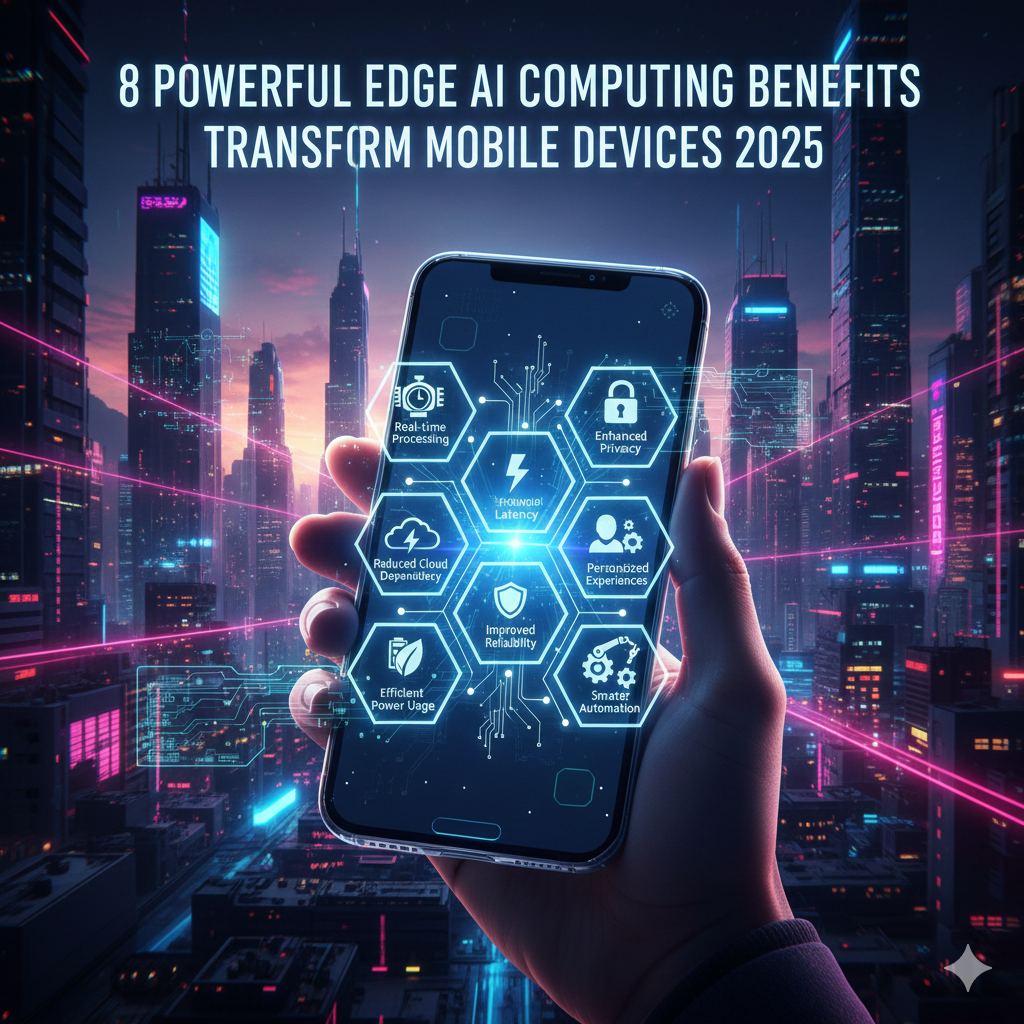
Edge AI computing moves artificial intelligence processing from distant data centers directly onto mobile devices, enabling instant responses, enhanced privacy, and continuous functionality without internet connectivity. Modern edge AI computing delivers sophisticated machine learning capabilities that once required cloud infrastructure, fundamentally changing how smartphones handle intelligent tasks.
This comprehensive analysis explores edge AI computing advantages, examining architecture differences from cloud-based approaches, comparing performance characteristics, and revealing how this technology enables next-generation mobile experiences.
[Image Alt Text: edge AI computing architecture diagram showing on-device processing flow]
Understanding Edge AI Computing
Contemporary edge AI computing represents paradigm shift in artificial intelligence deployment. Instead of sending data to remote servers for processing, edge AI computing performs computations locally on devices themselves using specialized neural processors.
This architectural change solves multiple problems simultaneously. Edge AI computing eliminates network latency, protects user privacy, reduces bandwidth costs, and enables AI functionality anywhere regardless of connectivity. The result: faster, more private, and more reliable intelligent features.
Technology leaders including Qualcomm, Apple, NVIDIA, and Google invest heavily in edge AI computing hardware and software, recognizing this approach as future of mobile intelligence.
Edge AI Computing vs Cloud AI
Understanding differences between edge AI computing and traditional cloud-based approaches clarifies advantages and tradeoffs.
Edge AI Computing:
- Processing happens on device
- No data transmission required
- Instant response times
- Works offline
- Complete privacy
- Limited by device capabilities
Cloud AI:
- Processing on remote servers
- Data must be transmitted
- Network latency present
- Requires connectivity
- Privacy concerns exist
- Access to massive computing power
The optimal approach often combines both—edge AI computing handles privacy-sensitive and latency-critical tasks while cloud processing tackles complex computations requiring more resources than mobile devices provide.
[Image Alt Text: comparison diagram edge AI computing versus cloud AI processing]
Modern frameworks like TensorFlow Lite and ONNX Runtime enable developers to deploy sophisticated edge AI computing models efficiently on mobile hardware.
Eight Major Edge AI Computing Benefits
1. Instantaneous Response Times
Perhaps the most noticeable edge AI computing advantage involves elimination of network latency. Processing data locally delivers results in milliseconds rather than seconds.
Latency Benefits:
- Real-time camera effects (no processing delay)
- Instant voice recognition (immediate transcription)
- Responsive assistants (no waiting for cloud)
- Smooth AR experiences (seamless virtual overlays)
Applications requiring immediate feedback benefit enormously from edge AI computing. Augmented reality, gaming, and photography all depend on low latency for usable experiences.
Cloud processing introduces minimum latency of network round-trip time—typically 50-200ms. Edge AI computing reduces this to single-digit milliseconds, making difference between acceptable and excellent user experiences.
[Image Alt Text: edge AI computing latency comparison chart showing speed advantages]
2. Enhanced Privacy Protection
Edge AI computing delivers superior privacy by processing sensitive data locally without transmission to external servers.
Privacy Advantages:
- Personal data stays on device
- No server-side data storage
- No interception risk during transmission
- User maintains complete control
- Regulatory compliance simplified
Face recognition, voice commands, and keyboard predictions benefit particularly from edge AI computing privacy. These features access highly personal information that users rightfully want protected.
Apple emphasizes edge AI computing privacy extensively, processing biometrics, Siri requests, and keyboard predictions locally whenever possible. This approach sacrifices some capability for significant privacy gains.
3. Continuous Offline Functionality
Edge AI computing enables AI features to work regardless of connectivity, making smartphones truly functional anywhere.
Offline Capabilities:
- Voice commands work without internet
- Photo enhancement functions everywhere
- Translation apps work internationally
- Navigation continues in tunnels
- Productivity tools remain available
Cloud-dependent features fail when connectivity disappears. Edge AI computing ensures critical functionality continues uninterrupted, whether you’re in airplane mode, remote locations, or areas with poor coverage.
[Image Alt Text: edge AI computing offline functionality demonstration scenarios]
4. Reduced Bandwidth Consumption
By processing locally, edge AI computing eliminates data transmission costs and conserves cellular bandwidth.
Bandwidth Benefits:
- No upload requirements (data stays local)
- No download of results (computed on device)
- Cellular data savings (reduced monthly usage)
- Faster processing (no network bottleneck)
Users with limited data plans benefit significantly from edge AI computing. Processing that might consume gigabytes monthly through cloud services instead happens locally without data charges.
5. Improved Reliability
Edge AI computing removes dependency on server availability, network connectivity, and cloud service operational status.
Reliability Advantages:
- No server outages affect functionality
- Network problems don’t disable features
- Service discontinuation impossible
- Performance consistent everywhere
- No API rate limits
Cloud services occasionally experience downtime. Edge AI computing eliminates this failure mode entirely—if your device works, the AI features work.
[Image Alt Text: edge AI computing reliability comparison cloud versus on-device]
6. Cost Efficiency
Both users and service providers benefit financially from edge AI computing compared to cloud-based alternatives.
Economic Advantages:
- Users: No cloud subscription fees
- Users: Reduced data charges
- Providers: Lower infrastructure costs
- Providers: Decreased bandwidth expenses
- Providers: Reduced energy consumption
As edge AI computing scales, cost advantages compound. Serving billions of AI requests through cloud infrastructure requires massive investment. Edge AI computing distributes this computational burden across user devices.
7. Personalization Without Compromise
Edge AI computing enables deep personalization while maintaining privacy through on-device learning.
Personalization Benefits:
- Models adapt to individual users
- Learning happens privately
- No data sharing required
- Immediate improvements
- Completely customized experiences
Keyboard predictions exemplify edge AI computing personalization. Your device learns your writing style, vocabulary, and patterns without sending typing data to servers. The result: predictions matching your style while protecting privacy.
[Image Alt Text: edge AI computing personalization learning process visualization]
8. Energy Efficiency
Modern edge AI computing architectures deliver remarkable energy efficiency, enabling always-on intelligence without battery devastation.
Power Advantages:
- Specialized neural processors (optimized for AI workloads)
- No network transmission (eliminating radio power consumption)
- Reduced computational load (optimized models)
- Efficient scheduling (smart resource management)
Always-on voice activation demonstrates edge AI computing efficiency. Continuously listening for wake words while consuming mere milliwatts of power enables convenient voice control without battery sacrifice.
Edge AI Computing Architecture
Hardware Components
Edge AI computing requires specialized hardware optimized for machine learning workloads.
Key Hardware:
- Neural Processing Units (dedicated AI accelerators)
- Optimized memory systems (high-bandwidth, low-latency)
- Efficient power delivery (milliwatt-level operation)
- Thermal management (passive cooling for sustained performance)
Companies design mobile processors with edge AI computing as primary consideration. The neural engine in Apple chips, Hexagon in Qualcomm processors, and Tensor units in Google devices all represent purpose-built edge AI computing hardware.
[Image Alt Text: edge AI computing hardware components neural processor architecture]
Software Frameworks
Deploying models for edge AI computing requires frameworks optimizing for mobile constraints.
Major Frameworks:
- TensorFlow Lite (Google’s mobile framework)
- CoreML (Apple’s optimization platform)
- PyTorch Mobile (Facebook’s mobile solution)
- ONNX Runtime (Microsoft’s cross-platform runtime)
These edge AI computing tools compress models, quantize weights, and optimize operations for mobile deployment while maintaining acceptable accuracy.
Model Optimization
Making models suitable for edge AI computing involves multiple optimization techniques.
Optimization Methods:
- Quantization (reducing numerical precision)
- Pruning (removing unnecessary connections)
- Distillation (training smaller models from larger ones)
- Architecture search (finding efficient designs)
Edge AI computing model optimization typically achieves 4-10x size reduction and 3-5x speed improvement with minimal accuracy loss—crucial for deployment on resource-constrained devices.
[Image Alt Text: edge AI computing model optimization process flowchart]
Edge AI Computing Applications
Computer Vision
Visual intelligence represents major edge AI computing application category enabling real-time image understanding.
Vision Applications:
- Face recognition (biometric authentication)
- Object detection (identifying items in camera view)
- Scene understanding (comprehending image content)
- Augmented reality (overlaying digital information)
- Photo enhancement (computational photography)
Edge AI computing makes these features instant and private—your face data never leaves your device, object recognition happens without uploading photos.
Natural Language Processing
Language understanding benefits significantly from edge AI computing, enabling private voice assistants and smart text features.
NLP Applications:
- Voice recognition (speech-to-text conversion)
- Intent understanding (grasping command meaning)
- Predictive text (keyboard suggestions)
- Grammar correction (writing assistance)
- Translation (language conversion)
Modern smartphones handle surprisingly sophisticated edge AI computing NLP tasks locally. Simple queries process entirely on-device; complex requests may use cloud assistance.
[Image Alt Text: edge AI computing natural language processing applications examples]
Audio Processing
Sound analysis through edge AI computing enables various intelligent audio features.
Audio Applications:
- Wake word detection (always-on voice activation)
- Music recognition (identifying songs)
- Noise cancellation (background elimination)
- Transcription (audio-to-text conversion)
- Speaker identification (voice recognition)
Always-on wake word detection demonstrates edge AI computing efficiency—continuously analyzing audio while consuming minimal power.
Sensor Fusion
Combining multiple sensors through edge AI computing creates richer understanding of context and environment.
Fusion Applications:
- Activity recognition (detecting walking, running, driving)
- Fall detection (emergency alerting)
- Gesture control (motion-based interfaces)
- Health monitoring (wellness tracking)
- Context awareness (understanding situations)
These edge AI computing applications process sensor streams continuously, detecting patterns and anomalies that trigger appropriate responses.
[Image Alt Text: edge AI computing sensor fusion multi-modal processing diagram]
Implementing Edge AI Computing
Development Considerations
Creating edge AI computing applications requires understanding mobile constraints and optimization strategies.
Key Considerations:
- Model size limits (storage and memory)
- Computational budgets (processing capabilities)
- Power constraints (battery impact)
- Thermal limits (sustained performance)
- Latency requirements (real-time needs)
Successful edge AI computing development balances these factors, delivering useful functionality within mobile device limitations.
Performance Optimization
Maximizing edge AI computing performance requires attention to multiple optimization dimensions.
Optimization Areas:
- Algorithm selection (choosing efficient approaches)
- Precision tuning (balancing accuracy and speed)
- Memory management (minimizing transfers)
- Scheduling strategies (coordinating workloads)
- Hardware utilization (leveraging accelerators)
Profiling tools help identify edge AI computing bottlenecks and optimization opportunities, enabling systematic performance improvements.
[Image Alt Text: edge AI computing performance optimization techniques comparison]
Testing and Validation
Ensuring edge AI computing applications work reliably across devices requires comprehensive testing.
Testing Aspects:
- Accuracy verification (model quality assessment)
- Performance benchmarking (speed and efficiency)
- Resource monitoring (memory and battery usage)
- Device compatibility (hardware variations)
- Edge case handling (unusual inputs)
Thorough testing catches issues before deployment, ensuring edge AI computing features deliver consistent reliable experiences.
Future of Edge AI Computing
Hardware Advances
Next-generation processors will deliver dramatically improved edge AI computing capabilities.
Coming Improvements:
- Higher TOPS ratings (more AI computational power)
- Better efficiency (performance per watt)
- Larger on-device models (increased capacity)
- Specialized accelerators (domain-specific hardware)
These advances will enable edge AI computing to handle increasingly sophisticated models, narrowing gaps with cloud-based processing.
[Image Alt Text: future edge AI computing hardware capabilities roadmap visualization]
Software Evolution
Edge AI computing frameworks and tools continue improving, simplifying development and enhancing capabilities.
Software Trends:
- Automated optimization (AI-assisted deployment)
- Cross-platform tools (unified development)
- Better debugging (improved visibility)
- Standardization (common interfaces)
These improvements make edge AI computing more accessible to developers, accelerating adoption across applications.
Application Expansion
Edge AI computing will enable new application categories currently impossible or impractical.
Emerging Applications:
- Real-time language translation (conversation-speed processing)
- Advanced AR experiences (sophisticated environment understanding)
- Personalized AI assistants (deeply customized intelligence)
- Health monitoring (continuous wellness tracking)
- Creative tools (AI-assisted content creation)
As edge AI computing capabilities grow, expect innovative applications leveraging instant processing, complete privacy, and offline functionality.
Conclusion
Edge AI computing represents fundamental shift in mobile artificial intelligence—moving from cloud dependence to device autonomy. The benefits are substantial: instant response, enhanced privacy, offline functionality, reduced costs, and improved reliability.
Technology continues advancing rapidly. Each processor generation delivers more edge AI computing capability. Software frameworks become more sophisticated. Models grow more efficient. The gap between edge and cloud AI narrows continuously.
For users, edge AI computing means better experiences—features that work faster, respect privacy more completely, and function reliably regardless of connectivity. For developers, it represents opportunity to build applications impossible with cloud-only approaches.
The future of mobile AI is local. Edge AI computing makes it possible, practical, and increasingly powerful. As these technologies mature, expect smartphones to become genuinely intelligent devices rather than mere cloud AI terminals.
The AI revolution doesn’t require sacrificing privacy, paying connectivity costs, or accepting network delays. Edge AI computing proves you can have sophisticated intelligence, complete privacy, and instant response—all in devices we carry everywhere.