

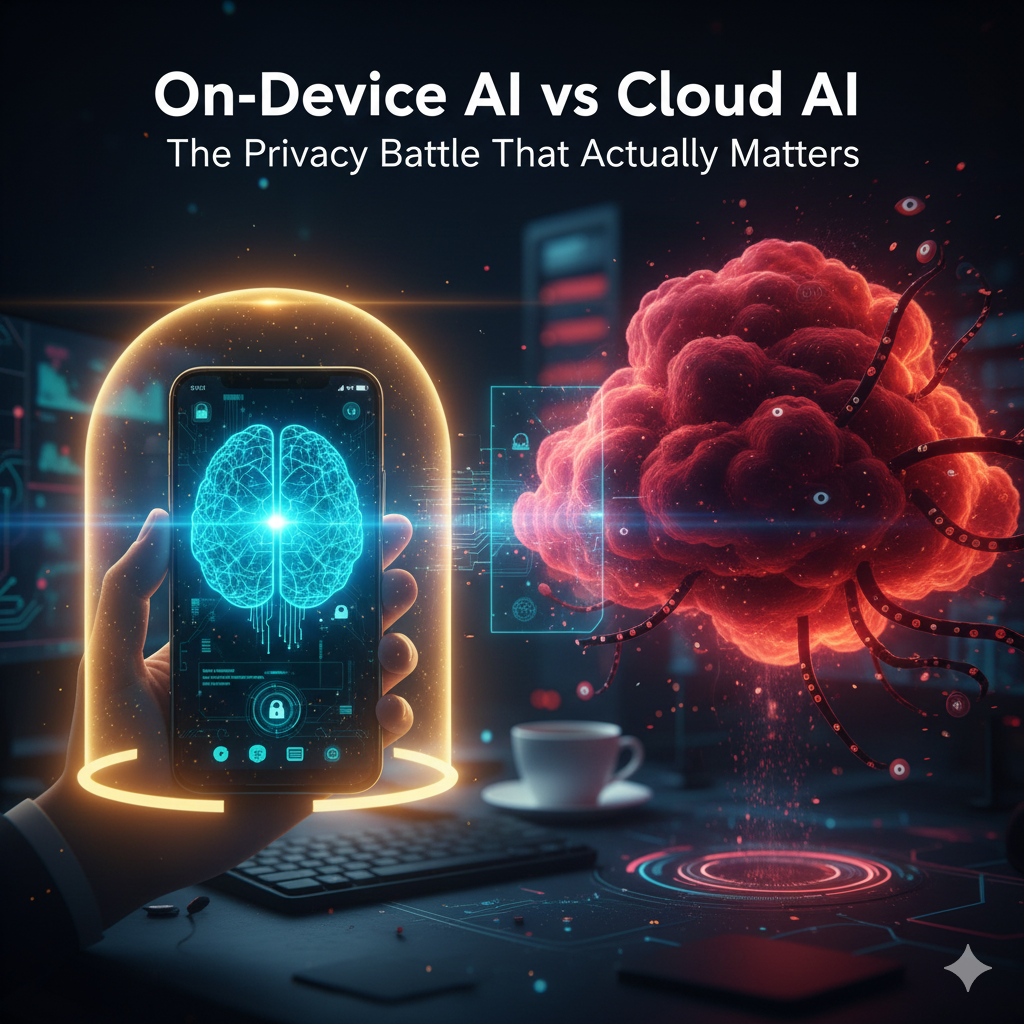
URL Slug: on-device-ai-privacy
Meta Description: On-device AI privacy protects your data completely. Discover the shocking differences between cloud AI and local processing, and which approach truly safeguards your information in 2025.
On-device AI privacy – every time you ask Siri a question, use Google Lens, or chat with an AI assistant, you’re making a privacy choice. Most people don’t realize they’re making it.
The question isn’t whether AI can be private. It’s whether the AI you’re using actually protects on-device AI privacy.
The Cloud AI vs On-Device AI Privacy Problem
Let’s start with what happens when you sacrifice on-device AI privacy by using ChatGPT, Claude, or any cloud-based AI service.
You type your question. Your phone encrypts it and sends it to distant servers. Those servers process your request using massive AI models. They encrypt the response and send it back. Simple enough.
[Image Alt Text: On-device AI privacy diagram showing data flow from device to cloud servers]
But here’s what most people miss about on-device AI privacy: your data passes through multiple points between your device and the AI. Each point is a potential vulnerability. More importantly, your conversation now exists on someone else’s infrastructure, compromising on-device AI privacy.
Learn more about mobile AI security best practices.
What Companies Actually Do With Your On-Device AI Privacy
The major AI companies have different policies affecting on-device AI privacy:
OpenAI (ChatGPT) and On-Device AI Privacy: Claims not to train on your conversations if you opt out. But your data still processes through their systems, impacting on-device AI privacy. They can see it. Their employees with proper clearance can access it for moderation purposes.
Google (Gemini) and On-Device AI Privacy: More transparent about data usage. They explicitly state they may use conversations to improve services, which affects on-device AI privacy. Your interactions help train future models unless you disable that setting.
Anthropic (Claude) and On-Device AI Privacy: Takes privacy more seriously. Doesn’t train on consumer conversations. But data still travels to and processes on their infrastructure, partially compromising on-device AI privacy.
[Image Alt Text: Comparison table of AI services on-device AI privacy policies]
Even with the best privacy policies, without true on-device AI privacy, you’re trusting these companies to:
- Secure their servers against breaches
- Follow their own stated policies
- Resist government data requests
- Not change policies in the future
The Types of Data On-Device AI Privacy Protects
When you don’t use on-device AI privacy features, you might be exposing:
Medical Information: “What do these symptoms mean?” might reveal health conditions you’d rather keep private. On-device AI privacy prevents this exposure.
Financial Details: “Should I invest in X?” or “How do I handle this debt?” exposes your financial situation. On-device AI privacy keeps this confidential.
Relationship Issues: Seeking advice about personal relationships reveals intimate details of your life. On-device AI privacy maintains your secrets.
Work Confidentiality: Questions about work projects could leak business-sensitive information. On-device AI privacy protects corporate data.
Personal Habits: Aggregate data about what you ask reveals more than individual questions. On-device AI privacy prevents profiling.
The AI companies aren’t necessarily malicious. But data breaches happen. Legal requirements force disclosure. Policies change. Once your information exists on external servers, you’ve lost on-device AI privacy control.
How On-Device AI Privacy Changes Everything
On-device AI privacy flips the model entirely. The AI runs locally on your smartphone’s processor. Your questions never leave your device. The processing happens in your pocket with complete on-device AI privacy.
[Image Alt Text: On-device AI privacy comparison showing cloud data journey vs local processing]
The On-Device AI Privacy Advantages
Zero Data Transmission: With on-device AI privacy, your conversation doesn’t travel anywhere. No encryption needed because nothing transmits. A hacker monitoring your network sees nothing.
No Server Logs: Cloud services maintain logs of queries for debugging, improvement, and sometimes legal compliance. On-device AI privacy creates no logs that anyone else can access.
Complete Offline Functionality: No internet? No problem. On-device AI privacy works in airplane mode, during outages, or in areas with no coverage. Your privacy doesn’t depend on connectivity.
No Terms of Service Concerns: With on-device AI privacy, you’re not agreeing to pages of legal terms determining how your data gets used. Your data simply doesn’t enter any system governed by corporate policies.
Discover more about Gemini Nano AI’s privacy features.
What On-Device AI Privacy Actually Protects
The on-device AI privacy benefits become concrete in real situations:
Healthcare Queries: Asking about symptoms, medications, or medical conditions generates zero external record with on-device AI privacy. Your health information genuinely stays private.
Financial Planning: Questions about debt, investments, or money management don’t get logged anywhere with on-device AI privacy. Financial services companies can’t correlate your AI usage with credit profiles.
Legal Questions: Researching legal topics or seeking information about rights doesn’t create records that could be subpoenaed when using on-device AI privacy.
Personal Development: Mental health questions, relationship concerns, or personal struggles remain completely confidential with on-device AI privacy.
[Image Alt Text: On-device AI privacy protection for sensitive queries illustration]
The On-Device AI Privacy Security Trade-offs
On-device AI privacy isn’t perfect. It has its own security considerations.
Device Security Matters More with On-Device AI Privacy
With cloud AI, your device security is one layer. With on-device AI privacy, it’s the only layer.
If your phone gets stolen or hacked:
- Cloud AI: Hacker gets access to your current session, but past conversations are on distant servers
- On-device AI privacy: Hacker potentially accesses conversation history stored locally
Mitigation for On-Device AI Privacy: Strong device encryption (enabled by default on modern phones), biometric locks, and regular software updates protect on-device AI privacy.
[Image Alt Text: Device security layers protecting on-device AI privacy]
Model Updates and On-Device AI Privacy Security Patches
Cloud AI gets security updates instantly affecting privacy. On-device AI privacy models require manual updates. If a security flaw is discovered in a model, you need to download and install a fixed version to maintain on-device AI privacy.
Limited Threat Detection with On-Device AI Privacy
Cloud services can monitor for malicious use patterns, bot behavior, or security threats across all users.
On-device AI privacy has no such oversight. In theory, this benefits privacy. But it also means no one’s watching for actual security threats targeting your device specifically while maintaining on-device AI privacy.
The Hybrid Approach to On-Device AI Privacy
Apple and Google are pioneering a middle ground for on-device AI privacy: process what you can on-device, send to cloud only when necessary.
Apple Intelligence and On-Device AI Privacy
Apple’s implementation is smart about on-device AI privacy:
On-Device First for Privacy: Siri attempts to process requests using on-device models, maximizing on-device AI privacy. Simple queries, common commands, and personal data access happen locally.
Private Cloud Compute: For complex requests requiring more power, Apple sends data to their own servers but uses specialized security maintaining aspects of on-device AI privacy:
- Dedicated chips that process data and immediately discard it
- No persistent logs affecting on-device AI privacy
- Verifiable by security researchers
- No way for Apple employees to access data
[Image Alt Text: Apple Intelligence tiered processing maintaining on-device AI privacy]
It’s not perfect on-device AI privacy—some data still transmits—but it’s substantially better than traditional cloud AI.
Google’s Approach to On-Device AI Privacy
Google’s hybrid model is less privacy-focused but more transparent about on-device AI privacy:
Explicit Choice: Android shows you which processing happens locally versus cloud, giving control over on-device AI privacy. You can often choose to wait longer for on-device results.
Federated Learning: Some model improvements happen by training on aggregated, anonymized data patterns without raw data leaving devices, partially preserving on-device AI privacy.
Clear Indicators: Apps must disclose when they’re using cloud versus on-device processing, helping users understand on-device AI privacy status.
When On-Device AI Privacy Really Matters
Not every AI interaction needs maximum on-device AI privacy. Asking about movie recommendations? Weather forecasts? Restaurant suggestions? Cloud AI’s convenience probably outweighs on-device AI privacy concerns.
But some use cases demand real on-device AI privacy:
Professional Confidentiality: Lawyers, doctors, therapists, journalists—anyone handling confidential information should default to on-device AI privacy.
Sensitive Personal Matters: Health, finances, relationships, mental health—topics you wouldn’t want in any corporate database need on-device AI privacy.
Political or Activist Work: Depending on your location, certain questions could put you at risk if logged externally. On-device AI privacy protects dissent.
[Image Alt Text: Decision tree for when to use on-device AI privacy vs cloud AI]
Business Proprietary Information: Discussing company plans, financials, or strategies with cloud AI could violate NDAs or leak competitive advantages. On-device AI privacy prevents leaks.
Learn how to run LLM on phone for maximum privacy.
The Practical On-Device AI Privacy Recommendation
Here’s the realistic approach for most people regarding on-device AI privacy:
For everyday, non-sensitive queries: Use cloud AI. The convenience, capability, and features may justify the on-device AI privacy trade-off.
For anything you’d feel uncomfortable sharing: Switch to on-device AI privacy. Medical questions, financial planning, personal problems, work confidential information.
For maximum privacy: Use on-device AI privacy exclusively. Accept capability limitations in exchange for complete data control.
The key is being conscious of the on-device AI privacy choice. Most people use cloud AI for everything without considering whether they should prioritize on-device AI privacy.
The Future of On-Device AI Privacy
The gap between cloud and on-device AI privacy capability is shrinking fast. Models get more efficient. Chips get more powerful. What required cloud processing last year runs on phones today with full on-device AI privacy.
What’s Coming for On-Device AI Privacy:
- Models approaching GPT-3.5 quality running entirely on-device
- Specialized privacy-focused AI chips in every smartphone enhancing on-device AI privacy
- Better hybrid approaches balancing privacy and capability
- Regulatory frameworks requiring clear on-device AI privacy disclosures
[Image Alt Text: Timeline showing evolution of on-device AI privacy capability]
Within three years, on-device AI privacy will handle most tasks currently requiring cloud processing. Privacy won’t require sacrifice.
Your On-Device AI Privacy Choice
The AI companies offer powerful services. Many genuinely try to respect privacy within their business models. But “respect” and on-device AI privacy “guarantee” are different things.
On-device AI privacy guarantees protection by making data transmission impossible. It’s not always as capable. It’s not always as convenient. But it’s unquestionably more private.
Understanding the on-device AI privacy trade-off lets you make informed choices. Use cloud AI when it makes sense. Use on-device AI privacy when privacy matters.
The worst choice is not realizing you’re choosing at all regarding on-device AI privacy.
Related Articles:
- NPU vs GPU for Private AI
- Run LLM on Phone Privately
- Gemini Nano AI Privacy Features
- Best Mobile AI Apps 2025